
Association DOVES – FEE Slovenia
Programme Eco-Schools | Greenovate Project Lead – Slovenia / National Coordinator for Young Reporters for the Environment & Eco-Campus | Circular Change Team Member
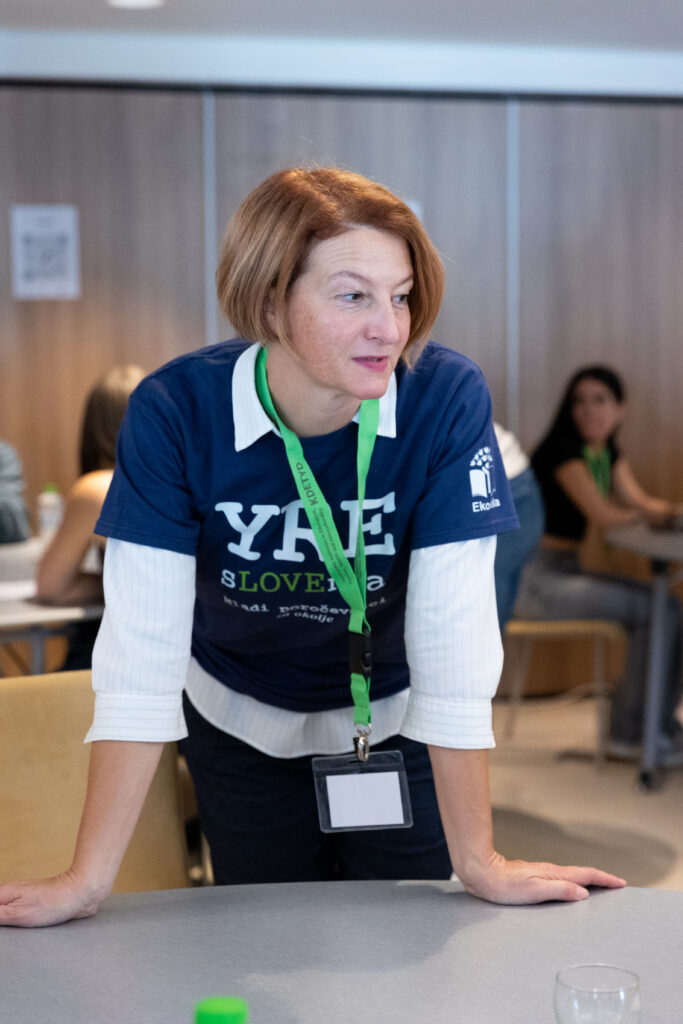
In today’s sustainability landscape, education goes far beyond traditional knowledge. It’s about mindset, empowerment, and meaningful action. For over two decades, Lucija Marovt has been co-creating sustainability and circular economy initiatives across corporate, civic, and educational sectors.
She is one of the driving forces in the Eco-Schools programme in Slovenia, a member of the Foundation for Environmental Education (FEE). As national coordinator for Young Reporters for the Environment and Eco-Campus, she connects youth, educators, academia, and industry. She is also in the team of Circular Change, a leading platform for embedding the circular economy into policy and practice across the EU, Western Balkans, and beyond, active and representing other networks as well.
You’ve been part of Eco-Schools for over 15 years and involved in many sustainability and circular economy initiatives. Can you describe your path?
My professional background is in marketing and communication. My first job in a large Slovenian company involved corporate communications, event management, and B2B marketing. Later, I worked at the country’s largest public relations agency, covering branding, corporate strategies, and campaigns across different sectors. I soon shifted focus to corporate social responsibility and environmental topics, collaborating with ministries, businesses, insitutes, NGOs, and eventually schools. It became clear that educational institutions cannot be treated as just another communication target – they need parallel taylor designed content and tools, not classical marketing approaches. That shift – which is learning – led me to gradually transition into the field of education for sustainable development and became a part of the Eco-Schools core team in Slovenia and being engaged in the global network as well. Since then, I’ve remained active in multiple teams and projects beyond the education field which goves me opportunity to bridge sector approach.
What role does education play in achieving sustainable development?
Education – I rather say learning – is the engine of change. And in the context of sustainable development, it needs a tailored, pedagogically grounded approach that embeds values and fosters active engagement and taking ownerships. We often hear about the green transition in terms of policy or technology – but without understanding, values, and behaviour, we won’t get far. My belief is simple: sustainability starts with understanding, and understanding begins with curiosity and learning.
So schools are at the heart of this?
Yes – but not schools only schools as institutions, rather as communities of teachers, experts, students, parents, experts. Of course, schools must meet curricular goals and learning standards – but to from a sustainability perspective to pass on essential values and skills within that- just like we teach reading or math, we should pass the environmental and climate literacy as something that is natually embedded. To achieve this, teachers need support: skills, knowledge, time, space, and trust. Fortunately, we’ve seen in the Eco-Schools programme how this is not only possible, but also creative, fun, and deeply motivating for everyone involved. For that, the commited and dedicated team behind the Eco-Schools programme in Slovenia works hard to create content, organize many events and support teachers.
Why is youth empowerment so important today?
Because young people are not only the future – they are the present. They have the creativity, digital fluency, and potentials our societies need. But they also need courage and support: space, trust, and meaningful roles as contributors – not just as “participants.” Through Eco-Schools, Young Reporters for the Environment, GLOBE, others, and now Participation Days, we go beyond awareness. We support youth in asking questions, investigating, telling stories, and leading change in their communities. But let’s be honest – this isn’t always easy. We are all navigating a digital world shaped by social media, AI, and new technologies, the social conetxt is very demanding. These are not external factors – they are part of our everyday lives, and we must learn to integrate them thoughtfully into learning and action.
Participation Days are one of the key activities of Greenovate. Why are they important?
Participation Days are more than events – they are immersive learning journeys. Young people from different countries come together to explore how sustainability connects to their lives, even if it’s not part of their formal studies. They share ideas, build friendships, and most importantly – realize that their actions matter.
Slovenia is hosting Participation Days in January 2026. What’s the focus?
Yes , we’ll host them, and the main theme will be the circular economy. The programme includes real-life industry visits, interactive workshops, and a chance to design solutions for circular challenges. Circularity is not new to Eco-Schools Slovenia — we’ve been integrating it into our programmes for nearly a decade, nut it is really a lot of work to do. It is an opportunity to go deeper and to understand it as a cross-cutting way of designing and implementing our lives.
Final message to educators and young people?
To educators: Don’t teach sustainability as a topic – teach it as a mindset. Create space for questions, exploration, and learning beyond the textbook. Education is a life itself.
To young people: Be bold, be curious, and act. Don’t wait for permission – your time is now. Every idea, every project, every action adds to the bigger picture of a sustainable and inclusive Europe.