
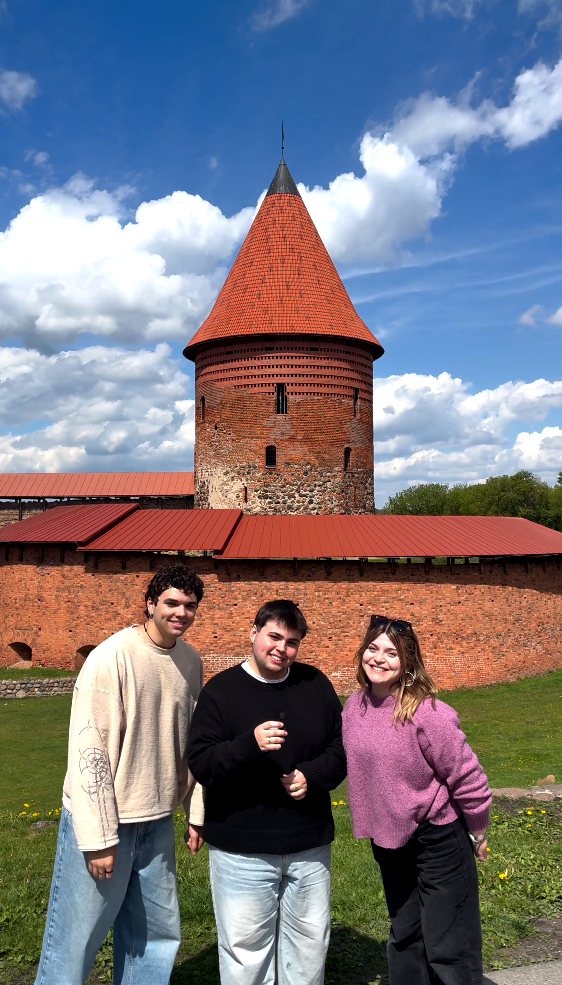
We sat down with three of our Spanish participants, Laura, Jose, and Álvaro, to hear about their experiences at the Participation Days Event in Kaunas and how it shaped their views on sustainability.
1. Before participating in EY-DGF 2.0, what did the European Green Deal mean to you?
LAURA: Before the project, the European Green Deal was little more than a headline to me. I had heard the term and knew it was connected to the environment and to the EU’s climate ambitions, but I did not really grasp its magnitude or what it actually involved. I understood it in a vague, surface way, without any real sense of how far-reaching it was or how it might connect to my own life. So it meant something I recognised but did not truly comprehend.
JOSE: Before participating in EY-DGF 2.0, I wasn’t familiar with the European Green Deal.
ÁLVARO: I had a brief idea of what the European Green Deal was because during my time in Inercia Digital I had to work on materials based on the deal, but before that I had no idea, maybe it sounded familiar but I couldn’t tell you what exactly was.
2. How has your perspective on sustainability and climate action changed after participating in the Participation Days Event in Kaunas?
LAURA: It has changed in a very positive way and made me far more aware of climate change and of my own role in it. Through the workshops and discussions I started to see sustainability less as a set of restrictions and more as a way of rethinking how we live, consume and relate to one another. What changed most was my sense of agency. I came away understanding that climate action is not only about governments signing agreements but about thousands of small, deliberate decisions made by communities and individuals. The event gave me a much clearer, more hopeful and more practical view of what is genuinely possible.
JOSE: After taking part in the event, my perspective changed regarding how sustainable projects and initiatives are implemented in places like Kaunas.
ÁLVARO: The Participation Days really changed my view in climate change and sustainability, especially in action take because I realized that we are much more important to the world that we think. Thanks to the workshops and activities we made it has really made me aware of the situation the world is at right now and it has opened my mind and inspired me to take action and help to build a better world.
3. Why do you think young people should play an active role in the European Green Deal and environmental decision-making?
LAURA: Because we are the generation who will live with the consequences, and because we bring a perspective that older decision-makers sometimes lack. Young people tend to think across borders, we are comfortable with rapid change, and we are quick to spot when something does not add up. If the Green Deal is designed without us, it risks being built for a future that does not reflect the people who will inhabit it. Including young voices is not a courtesy, it is a way of making policy more realistic, more ambitious and more democratic.
JOSE: Because in the future, young people will be the ones responsible for making important decisions.
ÁLVARO: I think that we should play an active role because our decisions will really make an impact for the future and we should be more considerate with the environment if we want to have a better world when looking at the future and generations to come.
4. During the event, was there any activity, discussion, or moment that especially inspired you? Why?
LAURA: The activity that stayed with me most was our visit to the waste processing facility. Seeing the sheer scale of it made me far more conscious of just how much rubbish we throw away every single day, and of how easily we fail to notice that the amount is genuinely staggering. It is one thing to be told we produce too much waste and quite another to stand in front of it. I was also struck by the people working on the project itself, by their dedication and by the effort that goes into managing something most of us never think about. That visit shifted the problem from an abstract idea to something tangible I could see with my own eyes.
JOSE: There was one activity I really enjoyed that involved acting in a theatre performance. I liked it because it allowed us to socialize with other young participants while also learning about sustainability.
ÁLVARO: My favourite activity was definitely the visit to the waste management factory because we could see in first person how the waste was separated and how each waste had their own process. And also I liked seeing how the compost was created.
5. In your opinion, how can digital tools and social media help promote sustainability and environmental awareness among young people?
LAURA: Since almost everything today happens on social media, it is only natural that it has become the main source of information for young people. That is exactly why it is such a powerful tool for sustainability. If we use these platforms to promote environmental awareness, we can reach our generation where they already are and make them far more conscious of the problem and far more willing to change it. Social media can turn complex issues into something accessible and shareable, and when it is used for honest education rather than empty gestures, it becomes one of the most effective ways to turn awareness into real action.
JOSE: By encouraging major influencers and public figures to speak up about sustainability on social media.
ÁLVARO: I think that social media is the most important tool for promoting nowadays specially among young people because we have incorporated it into our daily life. It is the best way currently to reach as many people as posible and to promote environmental awareness.
6. What are some sustainable habits or actions that young people can start implementing in their daily lives?
LAURA: There are plenty of accessible places to begin. Reducing single-use plastic, choosing public transport, walking or cycling, being mindful about water and energy use at home, eating more local and seasonal food, and repairing or reusing things instead of replacing them straight away all make a difference. Equally important is being a conscious consumer, asking where products come from and supporting brands that take sustainability seriously. None of these habits requires a dramatic change of lifestyle, and that is exactly why they work: they are realistic enough to actually stick.
JOSE: Recycling, using water more efficiently, choosing public transportation, and reducing the excessive use of technology.
ÁLVARO: Young people can start by recycling, using reusable bottles and bags, saving water and electricity, using public transport or bikes, and buying less fast fashion. Small daily actions can make a big difference for the environment.
7. How important is international cooperation in addressing climate change and achieving the goals of the European Green Deal?
LAURA: It is essential, because the climate does not recognise borders. Pollution, rising temperatures and biodiversity loss affect us collectively, so the response has to be collective too. Working alongside people from other countries during the project showed me how much we gain by sharing knowledge, comparing approaches and pooling resources. No single nation can solve this alone, and the strength of the Green Deal lies precisely in coordinating that effort across Europe. International cooperation turns isolated good intentions into something that can actually move the needle.
JOSE: Helping other countries learn how renewable energy is used and how sustainable projects are developed so they can use them as examples.
ÁLVARO: It’s really important. Climate change doesn’t respect borders, so countries need to work together to actually make a difference. The European Green Deal depends a lot on international cooperation because things like emissions, energy, and industry are global. If some countries don’t follow the same goals, it’s way harder for Europe to reach its targets.
8. What did you personally learn from meeting young participants from other countries during the event?
LAURA: I learnt that we have far more in common than I expected, and that our differences are a resource rather than an obstacle. Meeting people from other cultures taught me to listen more carefully, to question my own assumptions and to appreciate how local context shapes the way each of us understands sustainability. On a personal level it strengthened my belief in European collaboration and reminded me how enriching it is to build something together with people from very different backgrounds. I came home with new friendships and a much wider perspective.
JOSE: I learned about different perspectives from other countries, not only regarding sustainability, but also on everyday topics such as feminism and homosexuality. At the same time, they taught me words and expressions from their languages.
ÁLVARO: I learned that even if we come from different countries, we have a lot in common. It was cool to share cultures and traditions, and it also helped me see things from different perspectives. It was really fun to cooperate to help raise awareness about sustainability. Also I liked that I could practice my english.
9. After this experience, do you feel more motivated to participate in local or international sustainability initiatives? Why?
LAURA: Absolutely, far more than before. The project showed me that participation is not reserved for experts or politicians and that anyone willing to get involved can genuinely make a difference. Seeing the real impact of collective effort was hugely motivating, and it gave me both the confidence and the enthusiasm to keep going, whether that means joining initiatives in my own community in Spain or taking part in future international projects. I have gone from being someone who simply cared about these issues to someone who actively wants to be part of the solution, and I am excited to keep building on everything this experience gave me.
JOSE: Yes, I feel more motivated because I met many new people, and I’m interested in learning how sustainability is applied in other countries.
ÁLVARO: Yes, definitely. After this experience I feel more motivated to take part in local and international sustainability initiatives because I’ve seen how important teamwork and shared ideas are. It made me realize that even small actions can have a bigger impact when people from different places work together.
10. What message would you give to other young people who want to contribute to a greener and more sustainable future?
LAURA: Start now, start small, and do not underestimate your own influence. You do not need to have everything figured out or to make perfect choices, you simply need to begin and to stay consistent. Talk to people, share what you learn, get involved in projects like this one, and surround yourself with others who care, because change becomes much easier when it is shared. Your generation has more power than it realises, and the future genuinely depends on what we choose to do with it.
JOSE: I would tell them to start with small actions, because little by little we can build a more sustainable world.
ÁLVARO: I’d say just start with small things and be consistent. You don’t need to do anything huge: recycling, using less water and electricity, and cutting down on plastic already helps a lot. And don’t think it doesn’t matter, because if a lot of young people do their part, it really adds up and makes a big difference.