
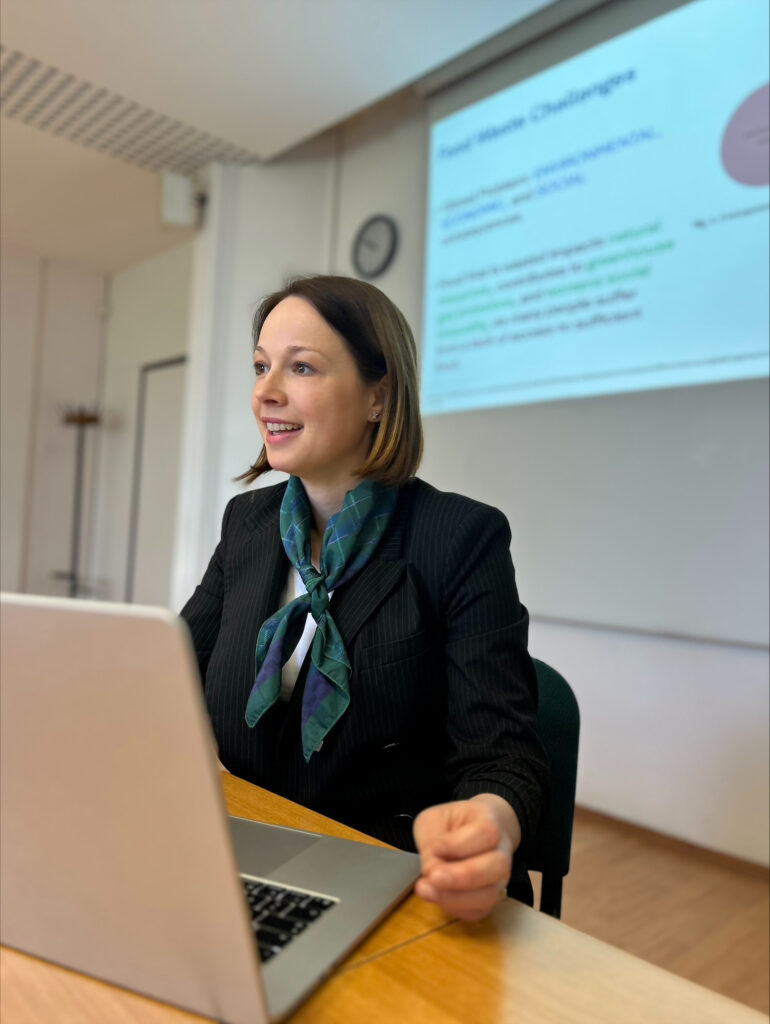
In this month’s #InTheSpotlight, we feature Dr Martina Erjavšek, a teaching assistant at the Faculty of Education, University of Ljubljana, in the Department of Biology, Chemistry and Home Economics. Her contribution to education for sustainable development is highly valuable and extends beyond formal curricula and standard teaching activities.
She is actively involved in education for sustainable development through collaboration with the Eco-Schools and Eco-Campus programmes in Slovenia. Her work focuses on nutrition and home economics education and literacy, with particular emphasis on sustainable consumption and the responsible use of resources. She also contributes to the development of teaching materials and delivers lectures and workshops on home economics and food education within the broader context of sustainability.
- From your perspective, what role does education play in shaping sustainable lifestyles, particularly in relation to food and consumption?
Education, particularly education for sustainable development, is essential for developing nutrition and environmental literacy, helping young people understand how their food choices affect their health, the environment, and society. Nutrition, consumer education, and sustainability are closely connected through the everyday decisions we make about what we eat, buy, and discard. A key challenge is helping students and future teachers grasp the complexity of the food system and translate this understanding into practical, responsible actions.
Schools can support long-term habits by linking knowledge with hands-on experience. For example, through my involvement in the Eco-Schools and Eco-Campus programmes in Slovenia, students and teachers engage in activities such as planning sustainable meals, reducing food waste, analysing food labels, and reflecting on their consumption patterns. These experiences make sustainability tangible and encourage lasting changes in daily behaviour, showing that even small, mindful choices can have a broader positive impact on both personal well-being and the planet.
- You encourage students to go beyond the classroom and explore real-world examples. How do you do that and why it is important?
I aim to go beyond the classroom by exploring real-life topics with my students and experts from Eco-Schools, such as textile waste, food waste, sustainable mobility, and packaging waste. Students research these topics and present their findings not only as seminar work but also in a reporter-style format through articles, interviews, or videos. This approach challenges them to step outside their usual comfort zone, and to succeed they need support, motivation, and a clear sense of purpose. I am often impressed by their creative solutions and approaches. Many other colleagues at the faculty are also implementing engaging ways to involve students.
- You are co-author of educational materials on circular economy that are developed by students at your faculty. How does this work, what is the idea?
Together with Dr Stojan Kostanjevec, we design extra-curriculum projects in which students develop lesson plans on circular economy topics, supported by external experts. The handbooks are both an outcome of the students’ learning process and a practical teaching tool for educators in kindergartens, primary and secondary schools. A key strength of this approach is that students build on real-life examples and translate them into engaging teaching activities, complemented by additional materials such as posters, videos or games. These handbooks are then tested by teachers within the Eco-Schools programme, who provide valuable feedback that helps us improve future editions. So far, we have developed a handbook on the circular economy and textiles (also available in English); a second, on food waste, is currently being finalised; and work on a third edition focusing on waste materials has already begun.
- This month’s theme is gender equality and empowerment. What does gender equality mean to you in the context of education and society?
Gender equality means equal opportunities, inclusive participation, and respect in learning environments and society. Education plays a key role in shaping attitudes and breaking stereotypes.
- Finally, can you share one concrete action you apply in your daily life to live more sustainably?
One simple but meaningful action I take is to check the expiry dates of products, whether food or cosmetics, before buying or using them, and only choose what I know I can actually use. This practical approach encourages mindful consumption, reduces waste, and demonstrates how small daily choices can make a positive difference.